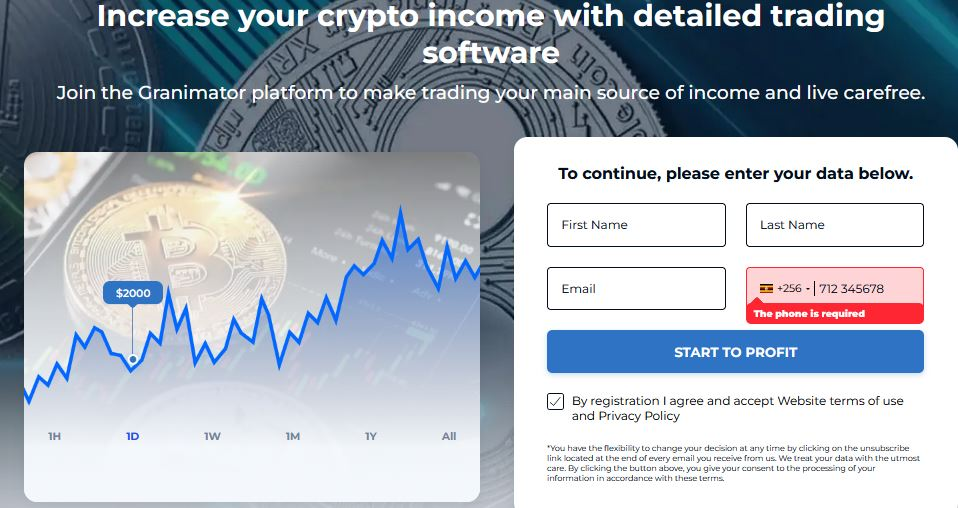
Granimator is marketed as an AI‑powered crypto trading and charting platform with automated bots, real‑time analytics, and portfolio tools, but safety evaluators and user reviews highlight serious scam red flags, unregulated operations, and aggressive sales tactics. Anyone considering Granimator or any “Immediate Granimator” variant should treat it as a very high‑risk product, use only money they can afford to lose, and strongly prefer fully regulated, mainstream exchanges for serious investing.
What is Granimator?
Granimator is presented as a crypto trading ecosystem that combines charting, portfolio management, and automated trading through an AI‑driven “trading robot.” Marketing copy on the official‑style sites describes it as a simple educational and trading hub that helps users learn about markets while letting algorithms execute trades on their behalf 24/7.
There are multiple branded variants—Granimator, Granimator AI, Immediate Granimator, and similar names—often funneled through campaign pages that promise fast returns and “up to 85% success rates.” In all cases, Granimator functions more as an interface and bot layer that connects users to third‑party brokers, rather than as a regulated exchange or wallet custodian itself.
How does the Granimator Platform work?
Granimator’s model follows a familiar funnel structure used by many AI‑bot‑style trading systems.
-
Sign up via the landing page
Users register with name, email, and phone on a Granimator or “Immediate Granimator” website, often after clicking ads that use celebrity images or fake news‑style pages.
-
Redirection to a partner broker
After registration, accounts are typically handed off to an associated CFD/crypto broker, where KYC and deposits are handled. These brokers are frequently offshore and not supervised by top‑tier regulators.
-
Deposit and bot configuration
Reviews indicate a minimum starting deposit of around 250 USD (or equivalent) is required to activate live trading. Users then set parameters such as investment amount, risk level, preferred cryptocurrencies, and whether to allow the Granimator bot to place trades automatically.
-
AI trading and signals
The “Granimator Trading Robot” claims to analyze large amounts of real‑time price data, identify trends and patterns, track whales and ATH (all‑time high) levels, and then execute buy and sell orders without emotional bias. It can place long and short positions, as well as limit orders based on user‑defined rules.
While this workflow sounds sophisticated, none of the performance claims are independently audited, and safety researchers note that fake “automated strategies” are a common hook in fraudulent platforms.
Core Features and Tools of Granimator Platform:
AI Trading Robot
Granimator’s main selling point is its AI trading robot, which is marketed as an automated system that:
-
Scans crypto markets around the clock for price patterns and momentum shifts.
-
Filters out emotional biases like FOMO by executing based on predefined logic.
-
Targets opportunities around ATH breakouts and large “whale” transactions.
The robot is supposed to help traders maintain discipline and react faster than manual trading, but external sources stress that such claims are unverifiable and often exaggerated.
Advanced Charting and Analytics
Some descriptive reviews call Granimator a “robust crypto charting and trading platform” with:
-
Real‑time price feeds and order book views.
-
Technical indicators for spotting trends and volatility.
-
Portfolio performance dashboards and historical analytics.
These tools are designed to appeal to both discretionary traders and those who rely on systematic strategies.
Manual + Automated Trading
Granimator supports both manual orders and automated execution:
-
Manual traders can open long/short positions and configure limit orders directly from the interface.
-
Automated mode lets the Granimator bot open and close trades within pre‑set risk and position parameters.
However, some independent reviews argue that manual features are relatively basic compared to established professional platforms.
Customization and Alerts
According to promotional materials, users can:
-
Choose which cryptos to trade and define individual risk levels.
-
Set custom alerts for price levels or market events.
-
Adjust strategies to focus on short‑term trading or longer holding periods.
This flexibility is pitched as making Granimator accessible to both beginners and experienced traders.
Fees, Costs, and Minimums
Granimator markets itself as “Free,” but there are always costs in financial trading.
| Fee Type | Cost | Notes |
| Registration | $0 | Creating an account is free. |
| Software License | $0 | No monthly subscription fee. |
| Commissions | Variable | The partner broker will likely charge spreads or commissions on every trade. |
| Minimum Deposit | $250 | Mandatory. You cannot access the live trading features without this deposit. |
| Withdrawal Fees | Unknown | Depends entirely on the broker you are assigned. Can range from $0 to $50+. |
Pricing, Deposits, and Fees
Granimator’s websites frame the software as “free,” but costs surface through broker deposits and trading conditions.
-
Registration fee: No upfront software cost is advertised; sign‑up is promoted as free.
-
Minimum deposit: Multiple reviews and copies around “Immediate Granimator” mention a typical minimum deposit of about 250 USD via the linked broker to activate live trading.
-
Trading fees: Granimator itself claims no extra commission beyond what the broker charges. Users still pay spreads, overnight funding, and any broker‑specific fees.
-
Deposit/withdrawal methods: Common methods include credit/debit cards, bank transfer, and sometimes e‑wallets, handled on the broker side.
Because brokers vary, actual fees and conditions differ from user to user, so reading the specific broker’s terms is critical.
Step-by-Step Registration Guide (Proceed with Caution)
If you still wish to test the platform to see if the “AI” works for you, follow these strict safety protocols.
Step 1: Protect Your Identity
Do not use your primary email address. Create a dedicated “Burner Email” (e.g., via ProtonMail) specifically for trading. This prevents your main inbox from being flooded with spam.
-
Phone Number: Be aware that once you enter your phone number, you will receive calls. You might consider using a secondary SIM or a VoIP number.
Step 2: Navigate to the Correct URL
Ensure you are on a secure site (looking for https://). Beware of “clone” sites that look identical but are phishing pages designed to steal passwords.
Step 3: Complete the Form
Enter:
-
First Name
-
Last Name
-
Email
-
Phone Number (with Country Code)
Step 4: Verification Call
You will likely receive a call within 10 minutes.
-
Golden Rule: Do not share your banking password or remote access to your computer (e.g., AnyDesk, TeamViewer). If the caller asks to “help you set up” by accessing your screen, hang up immediately. This is a common scam tactic.
Step 5: The Demo Phase
Before depositing, ask for access to the Demo Account.
-
Test the platform for 3-5 days.
-
If the Demo account shows you winning 100% of trades, be skeptical. Real markets have losses. If it looks too good to be true, it is.
Step 6: The Deposit
If you decide to proceed, the minimum is $250.
-
Payment Method: Use a Credit Card.
-
Why? Credit cards offer “Chargeback” protection. If the platform turns out to be a scam and refuses to refund your money, you can file a dispute with your bank. Never use Wire Transfer or Crypto Transfer for your first deposit, as these are irreversible.
Pros and Cons
Pros
-
User-Friendly: Designed specifically for people with zero crypto experience.
-
Automation Potential: If the algorithm works, it saves time on chart analysis.
-
Educational Resources: Access to basic guides and glossaries (on some versions).
-
24/7 Support: Claims to offer round-the-clock assistance (usually via the broker).
Cons
-
High Risk: Lack of regulation means your funds are not safe.
-
Aggressive Sales: High volume of sales calls reported by users.
-
Opaque Operations: You don’t know which broker you will get until after you sign up.
-
No Verified Track Record: No third-party audit of their trading performance (unlike public funds).
-
Withdrawal Issues: Common complaints about delays in getting money out.
Granimator vs Regulated Crypto Platforms
| Aspect | Granimator / Immediate Granimator | Typical Regulated Exchange/Broker (e.g., Coinbase, Kraken, eToro) |
|---|---|---|
| Core Product | AI trading bot + broker funnel for crypto CFDs | Direct access to spot and/or derivative markets |
| Regulation | Brokers behind Granimator are generally unregulated or lightly regulated | Licensed by financial authorities (e.g., FCA, SEC, CySEC, ASIC) |
| Reputation | Many scam reports, very negative user reviews, and safety warnings | Broad, long‑term user base and more balanced feedback |
| Marketing Tactics | Celebrity clickbait ads, fake news pages, high‑pressure calls | Standard digital marketing, no aggressive cold‑call funnels |
| Transparency | No clear audited performance, often anonymous or unclear operators | Public company info, visible leadership teams, detailed disclosures |
| Best For | Speculative, very high‑risk takers only (if at all) | Retail and professional traders, long‑term investors, institutions |
From a capital‑preservation and trust perspective, mainstream regulated platforms are much safer choices than Granimator.
Practical Safety Tips if You Encounter Granimator
If you land on a Granimator or Immediate Granimator site through ads or affiliate links:
-
Do not assume it is safe simply because of slick marketing or “official website” labels.
-
Avoid sharing more than minimal information; be prepared for persistent unsolicited calls if you submit your phone number.
-
Never deposit more than you can afford to lose, and treat any deposit as at high risk of loss.
-
Confirm whether the associated broker is regulated by a credible authority; if not, walk away.
-
Prefer established, regulated exchanges and brokers for real trading rather than funnel‑style AI bots with opaque backing.
Brief FAQs About Granimator
Q. What is Granimator Platform?
Granimator is a family of crypto trading platforms and bots, including variants like Granimator AI and Immediate Granimator, that claim to provide AI‑driven automated trading, real‑time analytics, and portfolio management through partnered brokers.
Q. Is Granimator a scam or legit?
Verdict: High Risk. While we cannot definitively label it a “scam” without a regulatory ruling, Granimator displays many characteristics of “high-risk lead generation” networks. The lack of regulation, anonymous ownership, and connection to offshore brokers make it unsafe for conservative investors.
Q. How much is the minimum deposit?
Most reviews mention a starting deposit of around $250 (or £250 / €250) through the connected broker to activate live trading, even though registration on the Granimator site itself is marketed as free.
Q. Can I use Granimator in the USA?
Likely No. The USA has strict regulations (CFTC) regarding CFD trading. Most offshore brokers connected to Granimator do not accept US citizens. If you are in the US, you should use regulated exchanges like Coinbase, Kraken, or Robinhood.
Q. Does Granimator guarantee an 85% success rate?
No, while some marketing content mentions success rates near 85%, there is no independent, audited performance data to substantiate these claims, and safety reports warn that such figures are typical of scam pitches.
Q. How do I delete my Granimator account?
Deleting an account on these platforms is notoriously difficult. There is usually no “Delete Account” button in the settings.
-
Action: You must contact the customer support of the broker you were assigned to.
-
Tip: If they refuse to close it, block their emails and phone numbers, and ensure no further payments can be taken from your bank.
Q. Does Granimator have a mobile app?
No official app exists on the Apple App Store or Google Play. Be careful of third-party apps using the “Granimator” name, as they may be copycats or malware. The official platform is web-based only.